Initiators
Vibeke BørdahlText
Jette Ross
(1936-2001)
Photos
Jens-Christian
Sørensen
Design
Traditional Oral Culture in the Modern Media World of Asia - The case of Chinese Storytelling
Project leader Vibeke Børdahl
Manager of database: Jens-Chr. Sørensen
Research assistants: Yu Jing, Ole Fossgård, Feng Yining, Hu Juan, Huang
Ying
Funding foundation: Norwegian Research Council, Program for Cultural
Studies
Project finalized July 2013. Main output > Publications > Books
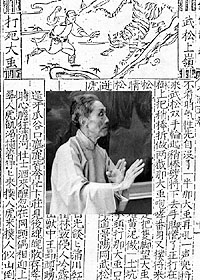 Chinese storytelling has an unbroken history of more than a thousand years. This professional art has survived in oral transmission to our present time, and therefore offers a unique territory for research in oral tradition. The profession is threatened by the modern society and the arrival of modern media-technology, but this situation also offers new possibilities for preserving the arts that are still alive today. The project investigates the interplay between oral and written traditions in the Chinese popular culture and the role of the new electronic media for this culture.
The relationship between oral and written traditions in the oral and oral-related genres of Chinese literature is investigated from a diachronic and synchronic descriptive perspective. Focus is on the story "Wu Song Fights the Tiger", handed down in written genres for reading and for performance since around 1300, and in oral genres of performance with broad distribution in different dialectal areas of China. The main topics of research are:
- The written legacy of storytelling in folk-book, novel, drama, and folklore works.
- The oral testimony of storytelling in the performed narrative arts of the last half century.
- Storytelling in the mediaworld - present conditions and possibilities for the future.
- The project includes the establishment of a research database on this website.
Output 2003-2014:
'The Storyteller's Manner in Chinese Storytelling, Asian Folklore Studies,
2003, Vol. 62-1, pp.65-112.
Tiger, tiger! Wu Song og tigeren i kinesisk historiefortælling [Tyger, tyger! Wu Song and the tiger in Chinese Storytelling] , with photos by Jette Ross, Vandkunsten Forlag, København, 2004.
(with Fei Li and Huang Ying eds): Four Masters of Chinese Storytelling. Full-length Repertoires of Yangzhou Storytelling on Video. Monograph with DVD 60 minutes. NIAS Press, 2004.
‘The Voice of Wang Shaotang in Yangzhou Storytelling’, CHINOPERL Papers, 2004-5, No.25, pp.1-33.
'Storytellers' Scripts in the Yangzhou pinghua Tradition', Acta Orientalia, 2005, No. 66, pp.227-296.
'A Drumtale on Wu Song Fights the Tiger', CHINOPERL Papers, 2006, No. 27, pp. 61-106.
‘The Man-Hunting Tiger from “Wu Song Fights the Tiger” in Chinese Traditions', Asian Folklore Studies, 2007, Vol. LXVI, 1-2, pp. 141-163.
(with Lucie Olivová, ed.): Lifestyle and Entertainment in Yangzhou , NIAS Press, Copenhagen, 2009, xxiv + 488 pp.
‘Written Scripts in the Oral Tradition of Yangzhou Storytelling', in Lifestyle and Entertainment in Yangzhou , edited by Lucie Olivová and Vibeke Børdahl, NIAS Press, Copenhagen, 2009, pp. 245-270
(with Margaret B. Wan, ed.): The Interplay of the Oral and the Written in Chinese Popular Literature, NIAS Press, Copenhagen, 2010, 274 pp.
“ Storytelling, Stock Phrases, and Genre Conventions--The Case of ‘Wu Song Fights the Tiger'”, in The Interplay of the Oral and the Written in Chinese Popular Literature , edited by Vibeke Børdahl and Margaret B. Wan, NIAS Press, Copenhagen, 2010, pp. 83-156.
‘Xiqu he shuoshu xushi fangshi de yitong – yi “Wu Song da hu” wei li' [Differences and similarities in the narrative methods of Chinese drama and storytelling], in: Xiqu yanjiu, Beijing , 2010, No. 80, pp. 116-131. Also in: Zhongguo xiqu lilun guoji xueshu luntan, Beijing , 2010.
‘Dialectal and normative registers in Yangzhou storytelling', in: Chinese Language and Discourse, 2010, Vol. 1, No. 1: 93-122.
‘ ‘Wu Song and the Empty Tavern' in Yangzhou Storytelling', in: China and Around. Mythology, Folklore, Literature , Russian State University for the Humanities: Orientalia et Classica: Papers of the Institute of Oriental and Classical Studies, Issue XXV, Moscow, 2010, pp. 412-26.
‘Two versions of “Wu Song Fights the Tiger” from the Yangzhou Pinghua Tradition', in: Victor H. Mair & Mark Bender (ed.): The Columbia Anthology of Chinese Folk and Popular Literature , New York : Columbia University Press, 2011: 433-471 .
‘ Chinese Storytelling—Transmission, Performance, Preservation. The Case of Yangzhou pinghua, in Folk Traditions in Modern Society, eds Pekka Hakamies, Vibeke Børdahl, Sun Jian, Shanghai: Fudan University press 2013 (in press)
‘ Layers of the Local in Yangzhou Storytelling Wang Shaotang Performs “Wu Song Fights the Tiger” (“Wu Song da hu,” 1961)', in: Yangzhou – A Place in Chinese Literature, Roland Altenburger, Margaret B. Wan and Vibeke Børdahl eds., Hawai'i University Press 2014 (in press).